Have you ever sat back and wondered what your parents were like when they were young, before you came along? Or their parents? Well, I did.
It’s the fall of 2026. Picture me sitting at home in Burbank, California, on an ordinary afternoon. The city is getting ready for the holidays. A question comes to me. What was life like for my mom when she was a kid? I’ve called you Mom my whole life. Somewhere back there, you were a little girl who called out “Mom!” and waited for Mary to turn around. What did that little girl sound like?
I was determined to see how far back we could go and how much family history I could uncover. Most of all, I wanted to remind my mother how incredibly special she is. So everyone, hop in the make-believe DeLorean. There’s room for everyone. Mom gets the front seat, though.
Our first stop, Germany, May 2, 1792. There’s a ship at the riverbank, and if we miss it, I have absolutely no idea how to reset this clock.1
Our make-believe DeLorean. A gull-wing door opens between the dates.
May 2, 1792 · Altona on the Elbe
The DeLorean lands
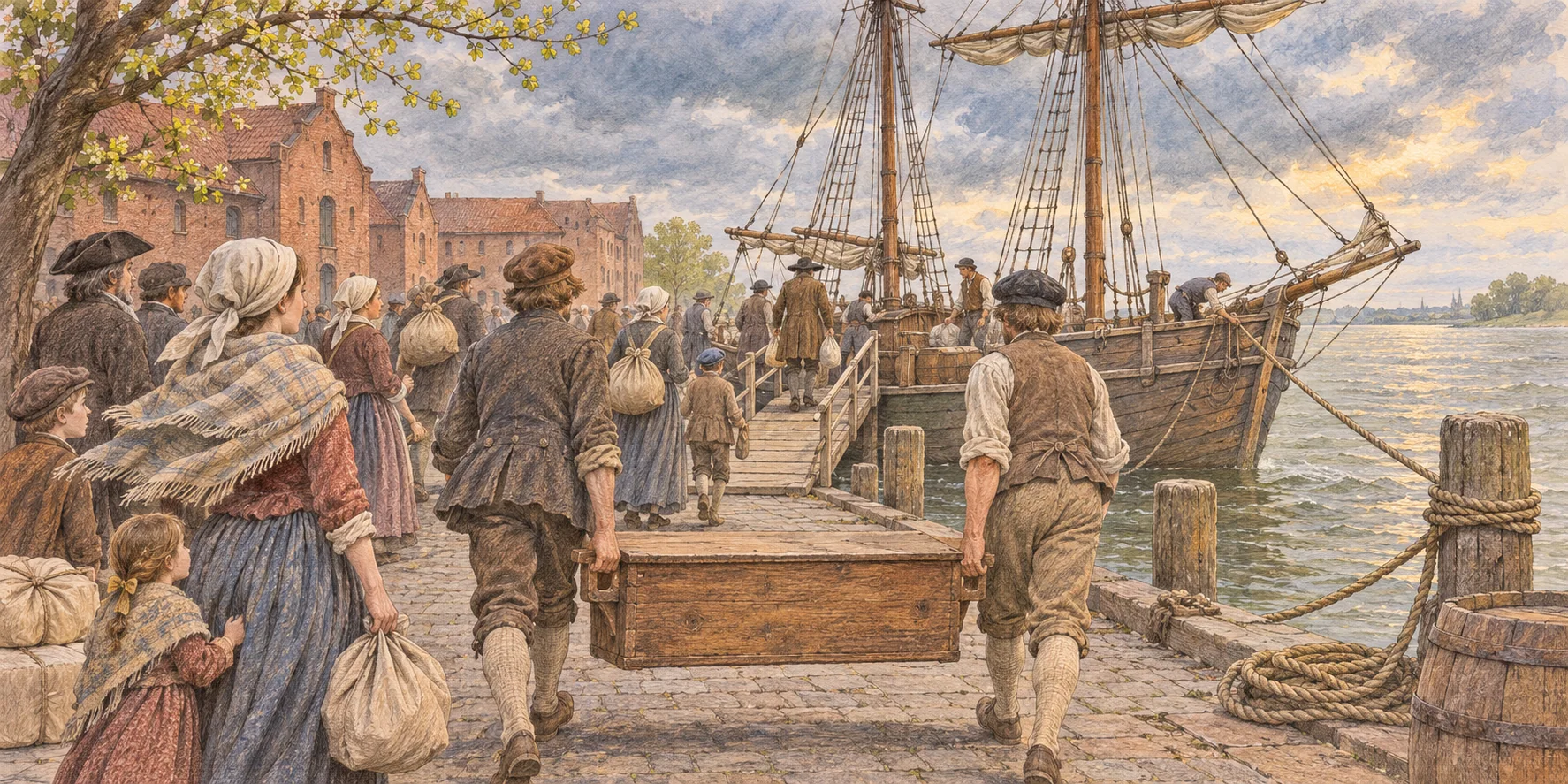
We step out on the bank of the Elbe River at Altona, beside Hamburg in present-day Germany. At the dock is the Catharina, bound for North America. It’s May 2, 1792. At least 132 people, the “settlers” in this story, are leaving everything they’ve ever known. They couldn’t even check the Google reviews for the place they were headed.
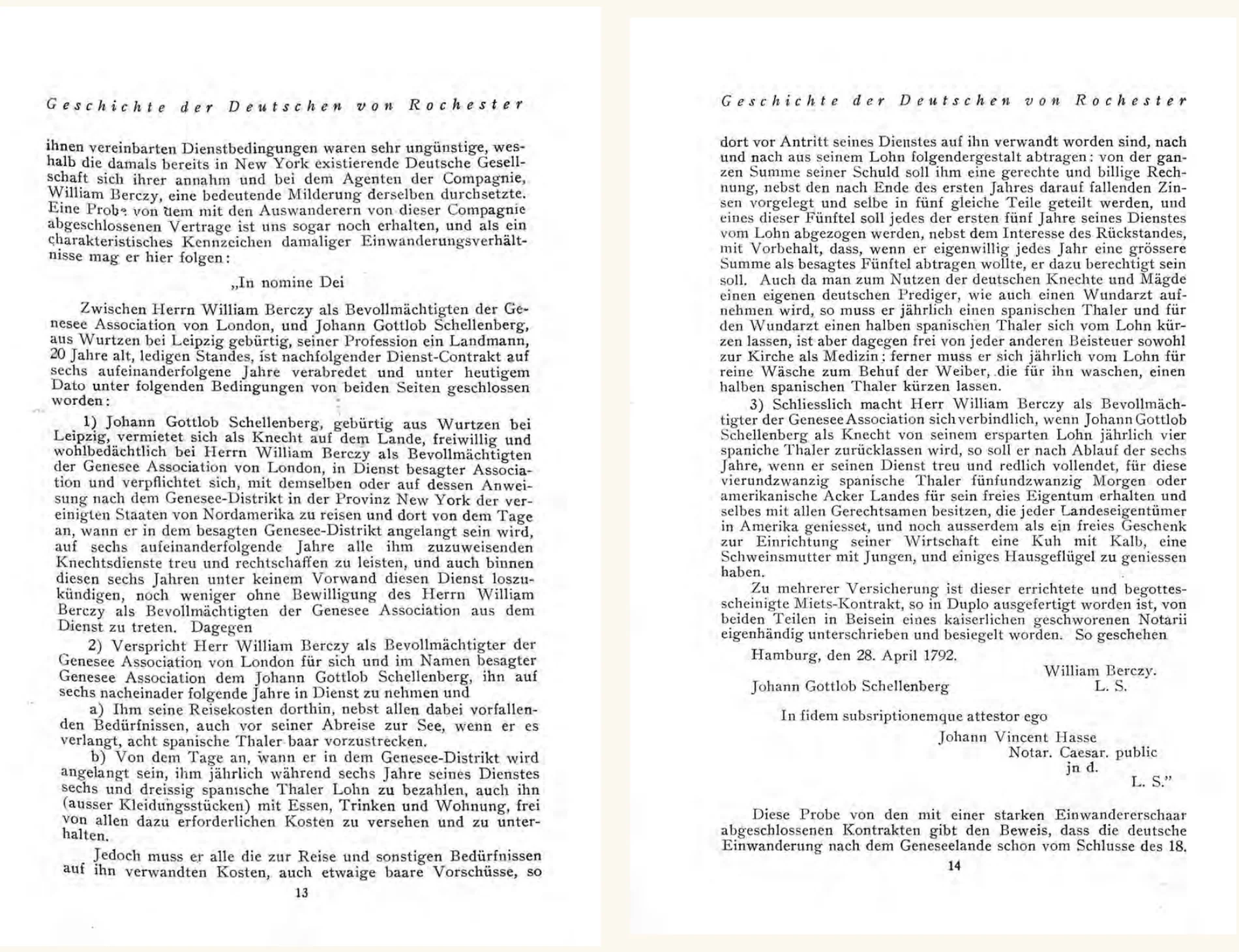
William Berczy recruited settlers for the Genesee country in New York. One of the people boarding the ship was Johann Gottlob Schellenberg. He signed up for six years of work. The company would advance his travel costs and pay him wages. If he kept his agreement and saved four Spanish thalers a year, he could earn twenty-five acres, a cow and calf, a sow and piglets, and poultry.
Think about being twenty and putting your name on that paper. Six years is a long time. But somebody has just told you that one day you might swing open a gate and the land on the other side could be yours. I can only imagine what each passenger was leaving behind that morning.1
1757 / 1792 · At the gangplank
Four feet of family baggage
Jochim Pingel boarded with his wife and their five children. We would later be tied to their family through marriage. They brought a wooden chest over four feet long. Let’s throw that in the back of the Tesla after baggage claim.
Here, look at it. That same chest is at Markham Museum in Ontario, Canada, today. The museum records the name and date carved into the chest as “Jochim Pingel 1757.”
There’s another person boarding the ship that day, too. His name is Philip Eckardt.2 · 3
May–July 1792 · The North Atlantic
Vinegar on the Atlantic
Altona’s waterfront had shipbuilders, sailmakers and ropemakers. Picture the smell of a freshly cut board, like the lumber aisle back home. Now put a wet rope in your hand and listen for the knock of a hammer. That’s how I imagine it.
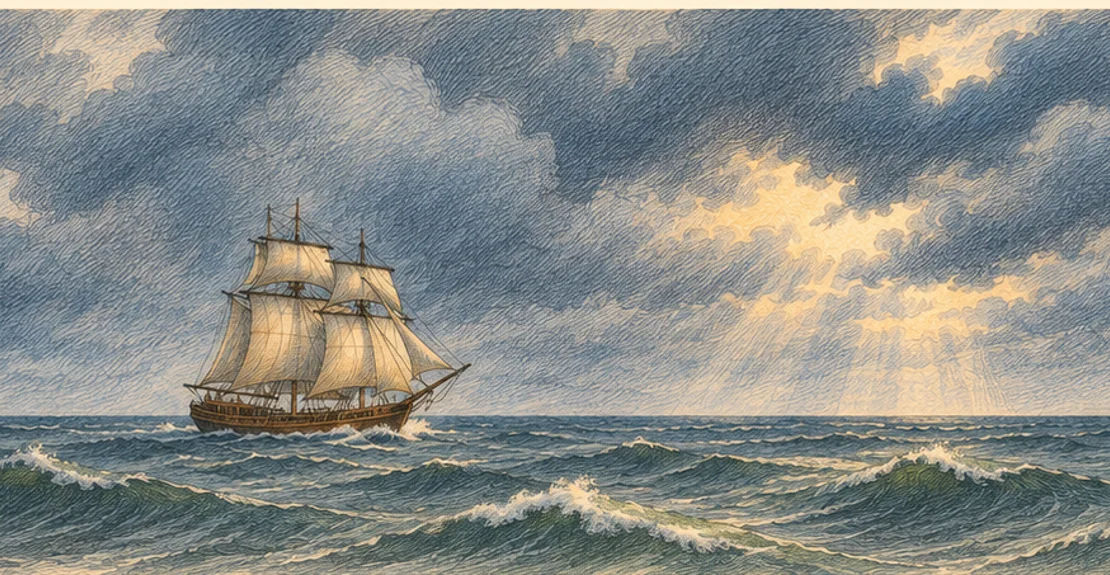
The ship traveled down the Elbe, into the North Sea, then out toward the Atlantic. I haven’t found a weather reading for the morning they left.
It’s May 8, 1792. We’ve been sailing for six days, and we’re finally reaching the open ocean. One passenger, John Henry Sommerfeldt, saw to the daily provisions. He wrote that they scrubbed the ship twice a week and fumigated it with vinegar and juniper berries. Open a pickle jar and think of a sharp, piney smell alongside it. Now imagine thirteen weeks at sea, which is how long he remembered the crossing. Thirteen weeks.1 · 3
Summer 1792 · Newport • Philadelphia
Water, water everywhere
Imagine being five years old on a ship with water in every direction and hearing that there might not be enough to drink. That was how old Francis Helmke was when his father, Johan, noticed the drinking water running low. The Catharina stopped at Newport, Rhode Island, to take on fresh water.
From there the Catharina sailed on to Philadelphia. They made it to Philly. Two hundred and thirty-four years later, the Phillies drafted your son Matthew.
On the passenger list, endorsed August 3, 1792, someone wrote the name “Pilip Ekhart,” age twenty-four. Your fourth-great-grandfather had made it across the ocean.
There he is, Philip Eckardt Sr. Now I can show you how we get all the way from his name on that ship’s paper to yours.3 · 4 · 13
1792 · Philadelphia and inland
Three days on an empty stomach
On the dock in Philadelphia, the ocean crossing was over. John Henry Sommerfeldt still had twelve wagons to load. He’d been going from store to store buying supplies. Shovels by the dozen. Spades by the dozen. Twelve dozen of each.
Three days it took to load those wagons. In his account of the journey, Sommerfeldt tells us what he ate over those three days. Nothing.
Farther up the road, he was the one baking bread. He had to carry in the firewood himself. Every other day, he supplied 125 loaves. Of all the people I’d like to have heard tell this story, he’s near the top of my list.3 · 4
Winter 1792–93 · Painted Post • Williamsburg
Christmas snow and two huts
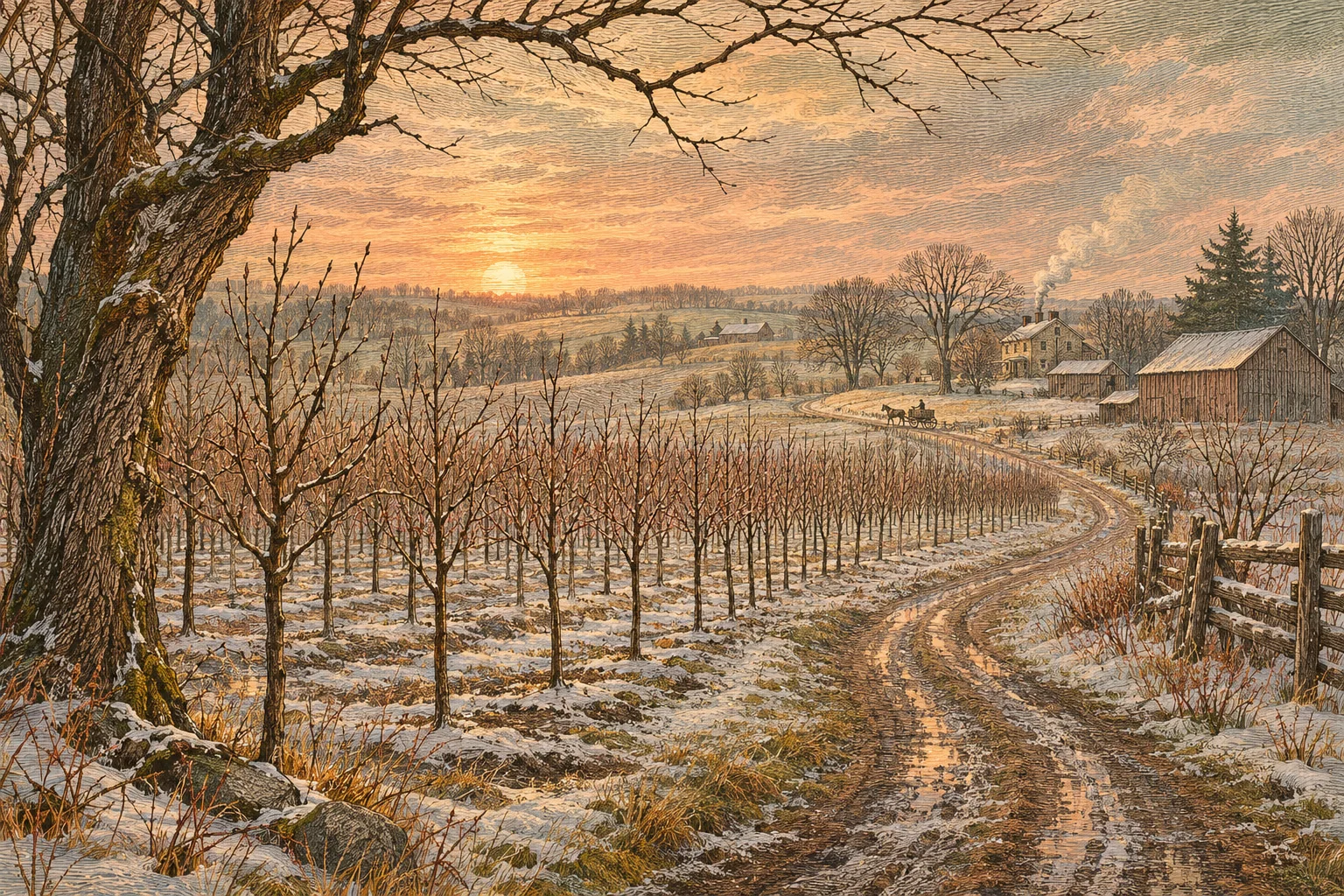
An imagined winter landscape.
By the time the travelers came down out of the mountains into Painted Post, New York, Christmas snow was falling. Some stayed there for the winter. Others pressed on toward Williamsburg, where houses and farmland were supposed to be waiting.
The first fifty men found two huts. In the settlers’ own account, the huts together couldn’t shelter twenty-five. There weren’t even pails to fetch water. One work party spent nearly five weeks in the woods with four axes to share among thirty men.
Then came the news that made the whole journey look different. Back in Germany, these families had signed on for a chance to own land. Here in New York, they learned they would be tenants. They could clear every tree, build the house, work the soil, and somebody else would still own the ground beneath their feet.
The settlement they had crossed the Atlantic for had failed. They were still here.4
1793–94 · Genesee • Upper Canada
Turn one page. There’s Philip.
Here’s the page I’d put my finger on. On August 6, 1793, the settlers put their complaint in writing. They described the huts, counted the axes, and set down what they had been promised. Near the end of the German document is Jochim Pingel, the man whose name is carved into the chest. Turn one page. There’s Philip.
A year earlier, somebody else had written down their names as they stepped off a ship. This time they put their names to their own account of what had happened to them.
The dispute reached the jail in Canandaigua, where some of the settlers were imprisoned. By 1794, families were ready to leave. Charles Williamson, the land company’s agent, posted guards to stop them.
Indigenous people from the Grand River helped the families get past those guards. Men hired by a merchant named Samuel Street helped, too. Most of the settlers made it through. By late June they reached Upper Canada, in what is now Ontario. They went on by way of York, today’s Toronto. By year’s end they had established a settlement in Markham.
I want our family to remember who lent a hand on that road. We’ve got Philip’s name on paper. We owe part of our story to people whose names that account never gives us.4
1794 and after · The Rouge River, Markham
A barge on the Rouge
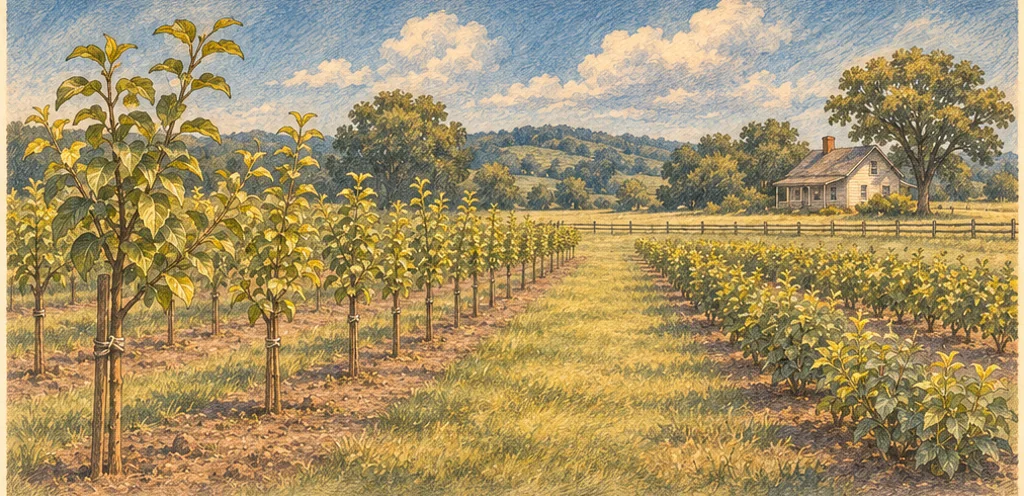
An imagined view of the next generation’s home in Markham.
Philip himself helped clear fallen trees from the Rouge River and built a flat-bottomed barge. I like knowing that about him. After everything that had stood in his way, we can still point to something he made so other people could get through.
And there in Markham, in 1794, Philip Eckardt married Ann Elizabeth Koepke, known as Elizabeth.
When one of my girls works hard for something and it doesn’t go the way they planned, I want to tell her this part of our family story. Philip had already crossed an ocean for a home that wasn’t there. He put his name on the truth of what happened. He accepted a hand when he needed one. And he kept going far enough to stand beside Elizabeth in Markham and begin a life with her. Neither of them could have imagined you. But when I think about what came of their perseverance, yours is the face I see.2 · 4 · 5
1792–2026 · Six generations
Six generations to Stephani
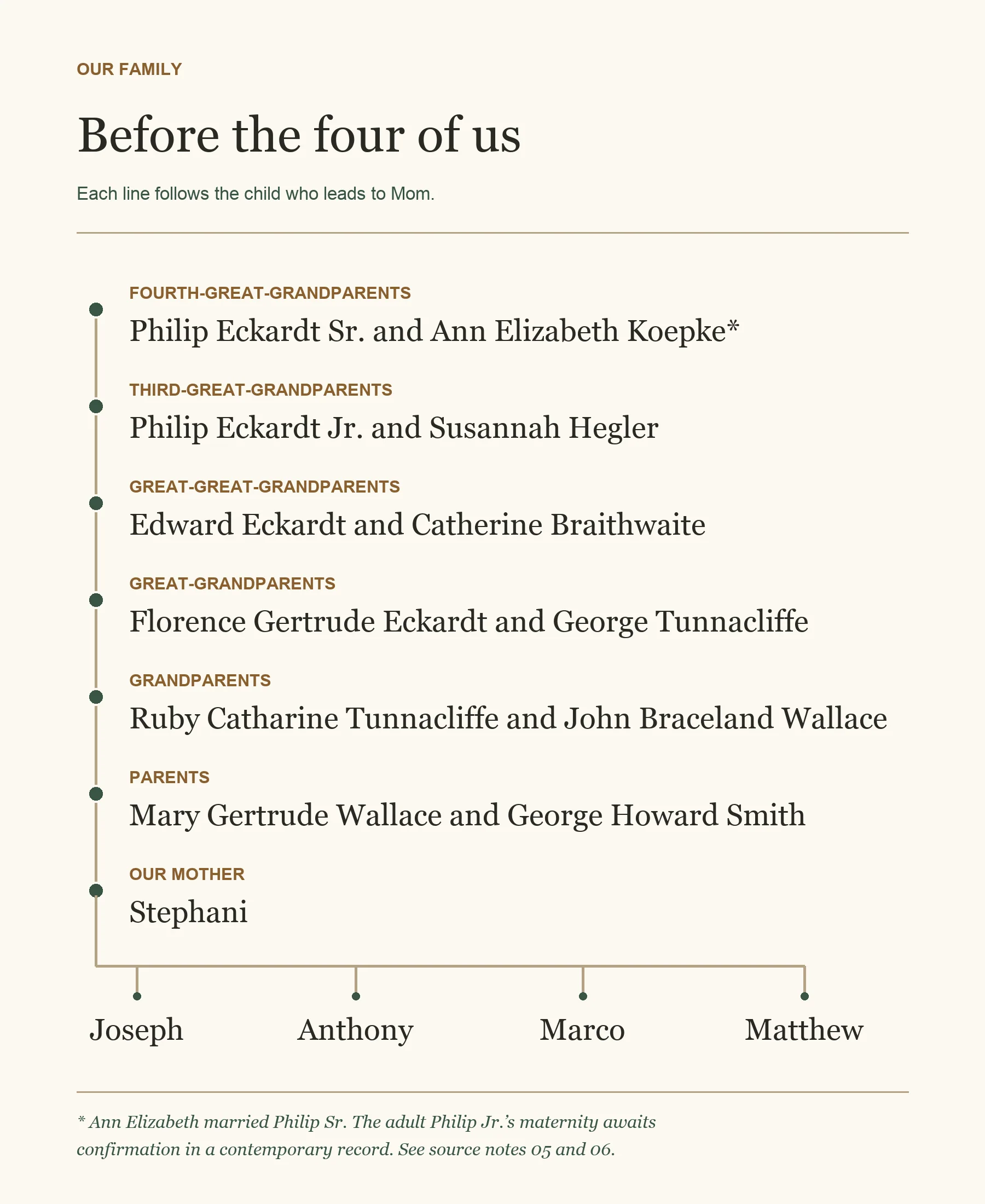
Philip Eckardt Sr. and Ann Elizabeth Koepke. Philip Jr. and Susannah Hegler. Edward Eckardt and Catherine Braithwaite. Florence Gertrude Eckardt and George Tunnacliffe. Ruby Catharine Tunnacliffe and John Braceland Wallace. Mary Gertrude Wallace and George Howard Smith.
Their daughter Stephani Smith is my mother. Her four sons are Joseph, Anthony, Marco and Matthew.5 · 6 · 7 · 8 · 9 · 13
1794–1824 · The Eckardt log house
Two sisters and one old chest
Philip was your fourth-great-grandfather. Ann Elizabeth, his wife, stands beside him in that spot on our family tree. Philip Eckardt had crossed the Atlantic on the Catharina. In 1794 he married Ann Elizabeth Koepke. Her sister Maria married George Pingel, the chest owner’s son. Two sisters are how that old wooden chest comes into our family story.
Philip and Ann lived in a log house in Markham, in what is now Ontario. Philip farmed, helped clear fallen trees and beaver dams from the Rouge River, and built a flat-bottomed barge. Their neighbors came to the house to pray. In the 1803 census, I can read the names of three boys at home with Ann. Philip was five. Henry was four. George was one.
The church remembers their daughter Mary, too. She was buried that year near the house, the first burial in what became the church cemetery. A historian counted eighteen children and a great-grandson remembered seventeen. We can still put names to only some of them, including Gottlieb, Frederick, Andrew, born in 1811, and Salem, born in 1824.5
1827–41 · The Markham farm
Four chimneys
Philip Jr. and Susannah Hegler were your third-great-grandparents. His father sold him a hundred acres in 1827. Two years later he married Susannah. Their brick farmhouse faced the Rouge River and had four chimneys. You raised four boys. I wonder what you’d have given for four bathrooms.
Their five children were Sarah Ann (1832), Thomas Philip (1833), Andrew (1837), Barbara Ann (1840) and Edward (1841). Andrew and Barbara Ann died young. Thomas became a doctor. Edward stayed on the land. Susannah and Philip belonged to the local congregation, and the visiting student minister lodged with them.6
1869–1901 · Markham • Pelham
Twins in the orchard family
Edward Eckardt and Catherine Braithwaite were your great-great-grandparents. They married in 1869. The Markham farm was sold in 1883. They got it back in 1886, with both their names on the land. By 1891 Edward was growing fruit in Pelham.
Across three censuses we can follow eight children: Homer (1869), Clarence (about 1871–72), Florence Gertrude (1876), Maude (1880), Jessie (1881), Eva (1883), W. Roy and Wilhelmina (both 1885). Florence grew up to work as an office clerk. Jessie became a teacher.
Look at those last two names. Roy and Wilhelmina have the same birthday, November 21, 1885. Florence was nine when she got a baby brother and a baby sister on the very same day.7
Dec. 23, 1915 · Pelham, Ontario
Two days before Christmas
Florence Gertrude and George Tunnacliffe were your great-grandparents. George worked in a nursery. When they married in Ridgeville in 1903, Florence’s sisters Eva and Maud signed as witnesses. Then came Jean Ladell in 1903, Eve Gwendolyn in 1905 and Marion in 1909.
On December 23, 1915, two days before Christmas, the girl who had grown up with twins had twins of her own. Ruby Catharine was your grandma. Ruth Eliza was her twin sister. Their little brother Donald came along about 1918–19.
Florence registered both girls’ births. Ruby is at the upper right of the page and Ruth at the lower left. More than a century later, I still have to move my eyes clear across the page to find both your grandma and her sister.8
1940 / 1946 · Welland, Ontario
June 22 again
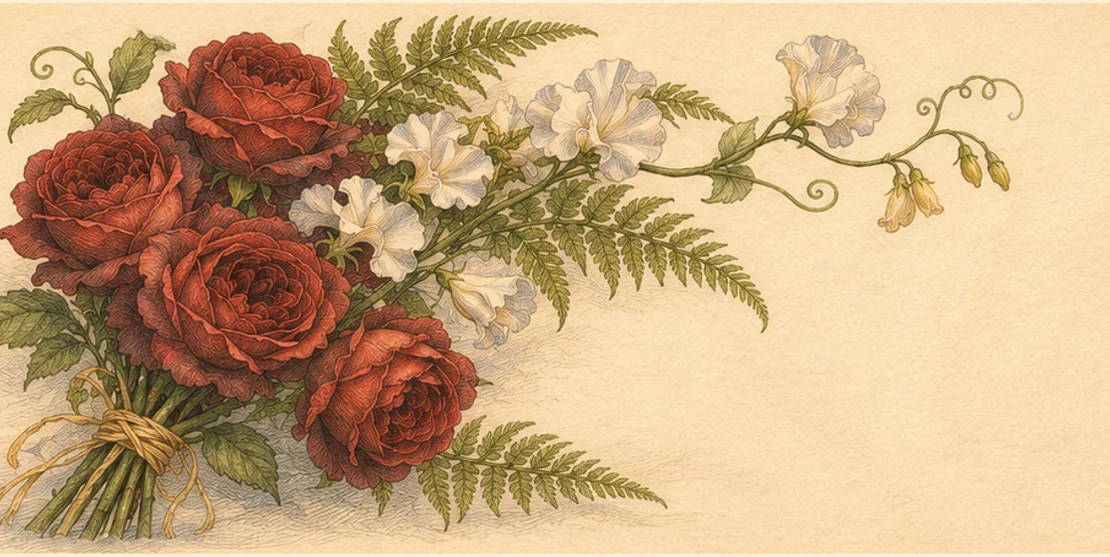
Ruby’s bouquet, imagined from the Welland–Port Colborne Evening Tribune, June 25, 1946, page 3. The attendants wore red roses, white sweet peas and fern in their hair and carried matching bouquets.
The twins were fifteen when Florence died. Nine years later, on June 22, 1940, Ruby married John Braceland Wallace, your grandpa, in Welland. They made their home in Detroit.
Six years later Ruth walked into St. Andrew’s Presbyterian Church to marry Edwin Hilder. Beside her stood Ruby, with red roses, white sweet peas and fern in her hair. Look at the date. June 22 again. Your grandma spent her sixth wedding anniversary standing up for her twin sister.
Their mother had Eva and Maud at her wedding. Ruth had Ruby at hers.8
1942–60 · Detroit • Glendale
Mary Wallace, Glendale High
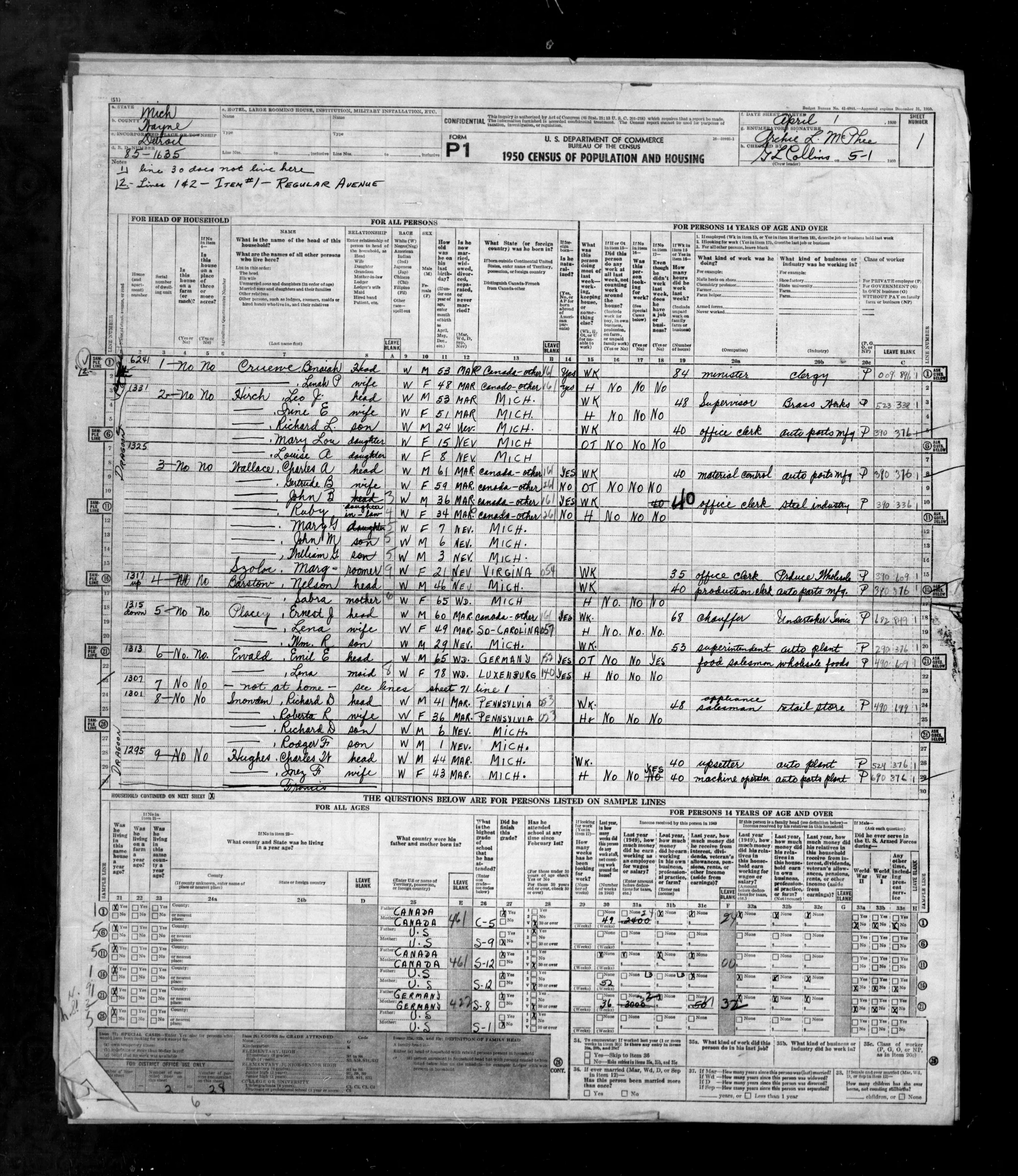
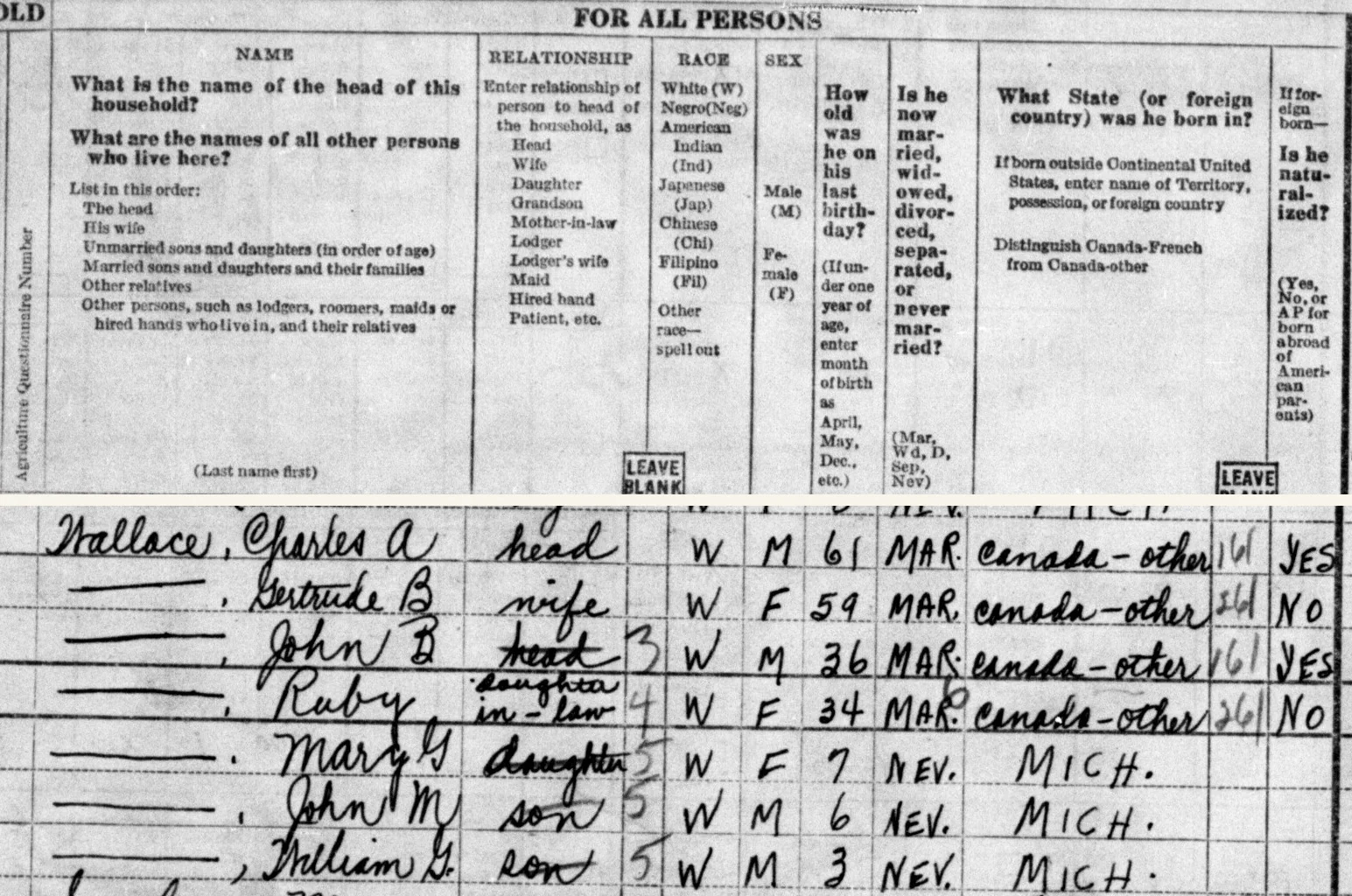
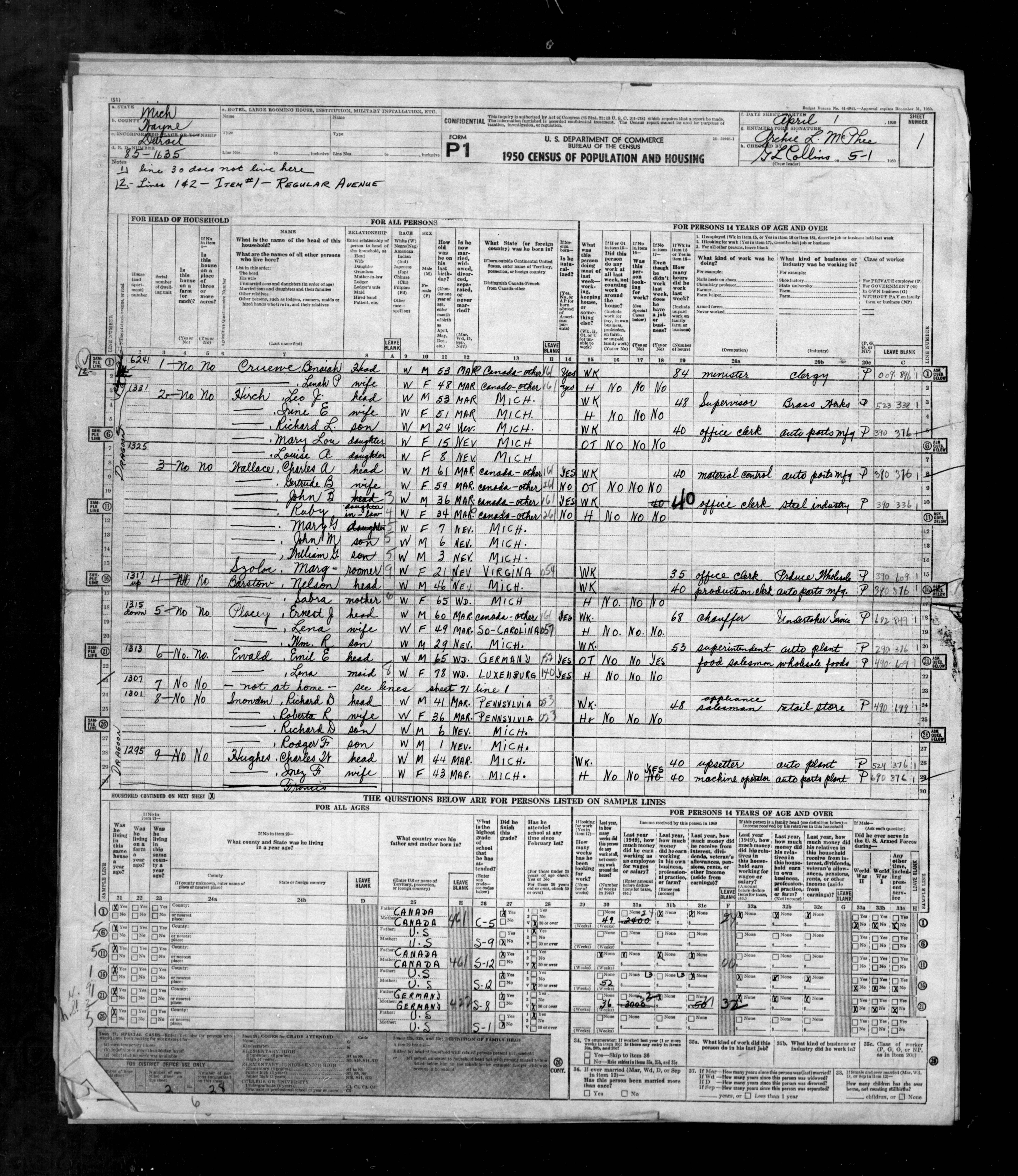
Ruby and John’s daughter Mary Gertrude Wallace was your mother. She was born in Detroit on April 8, 1942. At the 1950 census she was seven. Her brothers John, later called Mike, and William, called Bill, were six and three. Their birth years work out to about 1943–44 and 1946–47.
Their sister Anne is the Auntie Anne who later invited everybody to Utah to honor Mary.
Then there’s this picture. Your mother in the Latin Club at Glendale High. Her name is printed on page 93. I think I recognize her among the standing girls near the right. In the album you can see the whole yearbook page, then look a little closer for yourself.
Down at the bottom, the students tell us their club gave three scholarships and held a cookie sale to help pay for them. I knew Mary as my grandma. Here she is, still in high school, with a whole life ahead of her.9
Mar. 13, 1963 · Glendale, California
Mary and Ruby on the dial
Wednesday, March 13, 1963. Glendale. Up in the foothills, Bob Gregg penciled two numbers into his weather log that day. The low was 41 degrees. The high was 79. Mary was twenty. Her little boy Kevin had been born in 1961. Now she had a daughter, and she named her Stephani.
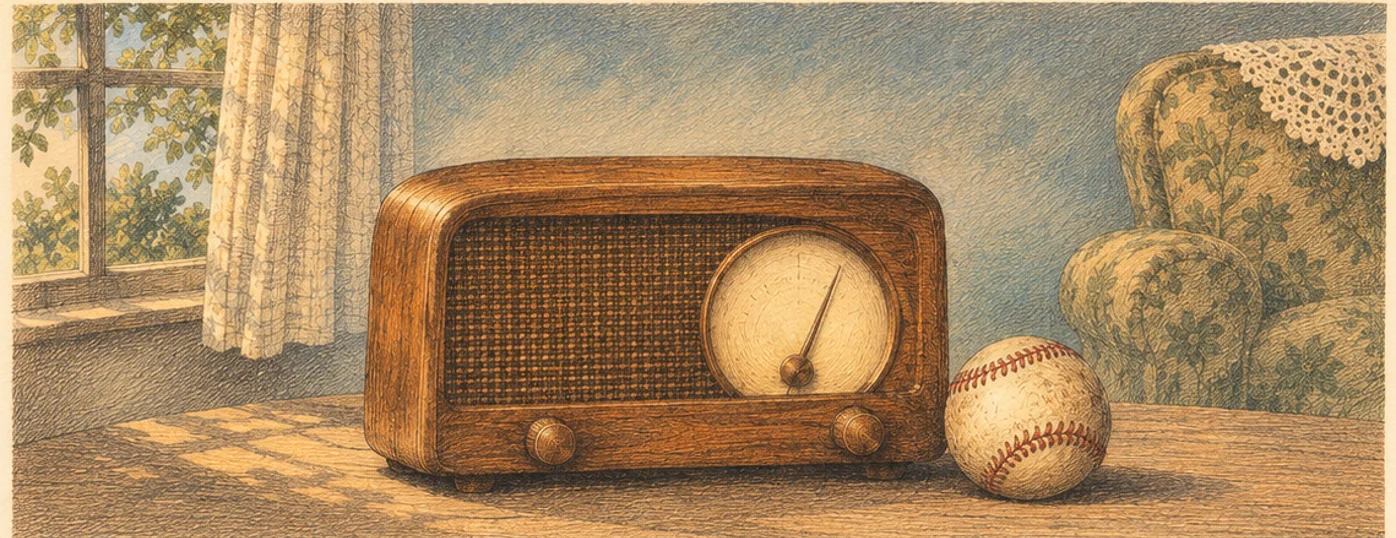
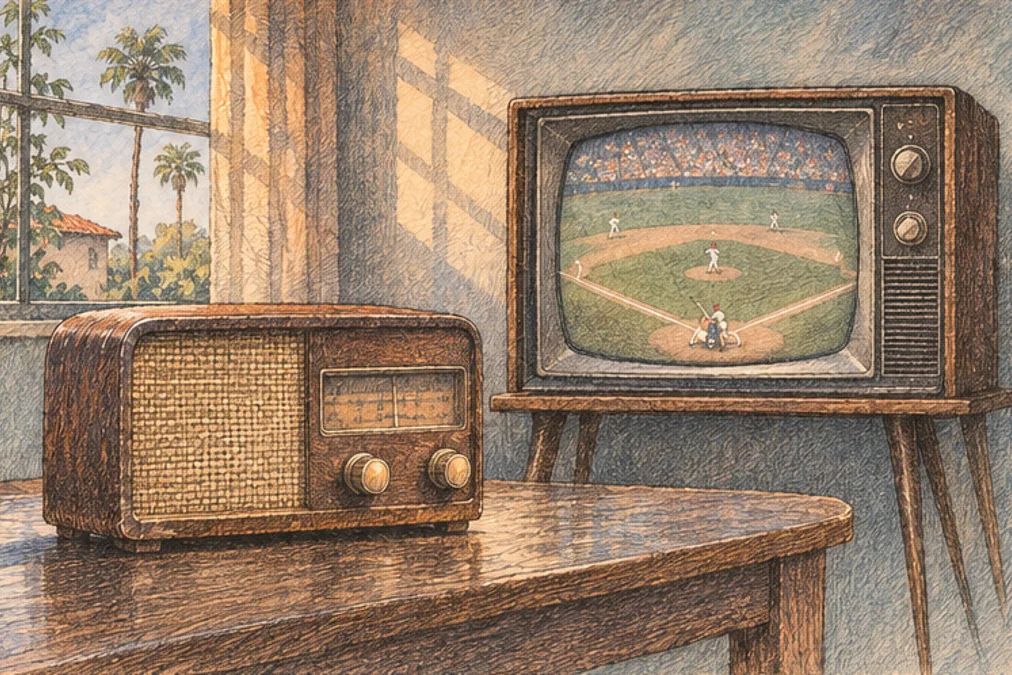
I don’t have a photograph of the room where you were born. I do have a radio dial. Let’s see what we can hear.
Imagine turning the knob very slowly. The number-one record in America that week was “Walk Like a Man.” One place down the chart came Ruby and the Romantics singing “Our Day Will Come.” A little farther down came Johnny Mathis singing “What Will My Mary Say.”
The baby’s mother was Mary. Her grandmother was Ruby. I went looking for the music from the week my mom was born and there was her family on the dial.
Ten days after you were born, the record I’d pick for you reached number one. “Our Day Will Come.”
In Los Angeles the Yellow Cars were still running. Their last scheduled runs came eighteen days later.9 · 10 · 11
Mar. 13, 1963 · At Mary’s bedside
Hello, Stephani
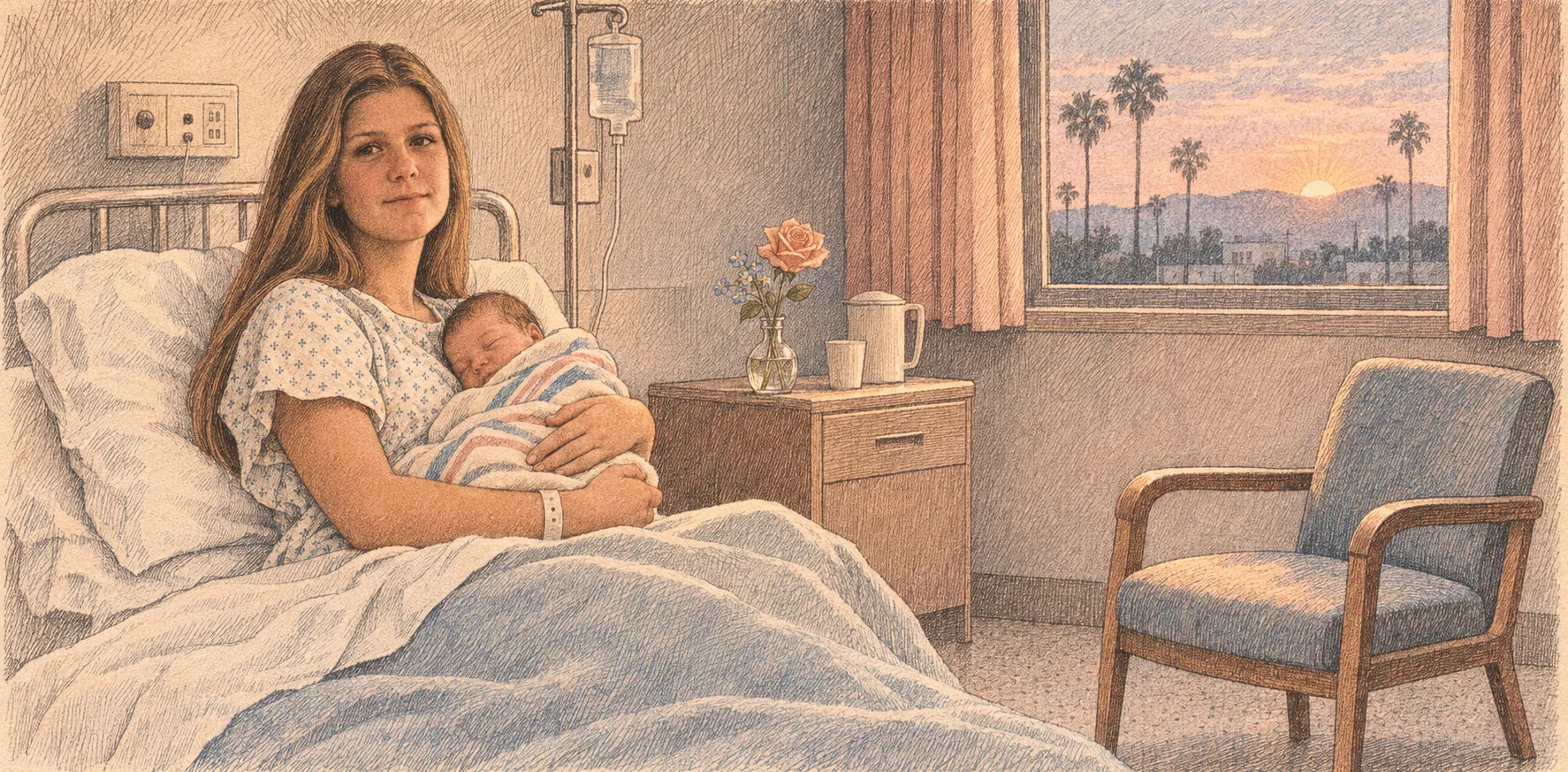
Mom, if I could walk into that room, I’d have to introduce myself. My voice wouldn’t mean a thing to you yet.
“Hi, Stephani. I’m Joseph. You and I are going to know each other pretty well.”
I imagine Mary looking up. “You’re her son?”
“Her first,” I’d say. “There’ll be four of us. Maybe save that news for tomorrow.”
Then I’d ask, “Grandma, could I hold her a minute? Someday I’ll have a little girl, too. The name you gave my mom today? I’m going to give it to her. We’ll add one more e.”10 · 12 · 13
1963–81 · Burbank, California
Before everyone needed you
You remembered that Mary had five boys and three girls. The boys’ names I remember are Kevin Smith, Timmy Smith, Ricky Gaughn, Michael Gaughn and Patrick. The girls are Stephani Smith, Windy Gaughan and Cindy Gaughan. Patrick was adopted and later reunited with the family. He’s one of your brothers.
Your father George Howard Smith’s notice names Christopher Smith and Carol M. Smith, too. His later marriage brought two stepbrothers, Jim Trucano Harp and Eric Harp.
You went to John Burroughs High School in Burbank. Years later, Anthony and I went there, too. Before the four of us ever called you Mom, before everyone needed you, you were just Stephani.
In March of 1981 you turned eighteen. For almost two months you were eighteen and still had all four of us boys ahead of you.11 · 12
1963 / 1981 · Los Angeles • New York
Two babies, two World Series
The year Mary had you and the year you had me.
The fall of 1963. You’re six months old, Mary’s baby girl, and the Dodgers sweep the Yankees in the World Series.
Friday night, May 8, 1981. Shea Stadium, New York. The Dodgers give Fernando Valenzuela one run to work with. He pitches the first inning, the ninth, and every one in between. Eleven Mets strike out. Dodgers one, Mets nothing. I’d have loved to hear Ruby’s radio that night.
Saturday, May 9, in Mission Hills, along comes another Valenzuela. Joseph Valenzuela. Your first boy, Mom. Three more would follow. You were eighteen years and fifty-seven days old. Mother’s Day was the next morning. Your very first Mother’s Day.
That October, I’m five months old, your baby boy, and here come those Yankees again. The Dodgers lose twice. Fernando wins the third game, and Los Angeles takes all three after that. Another World Series for the Dodgers.
Two babies, two championships. You’d think they could at least get us tickets.12
May 10, 1981 · Mission Hills, California
Five minutes
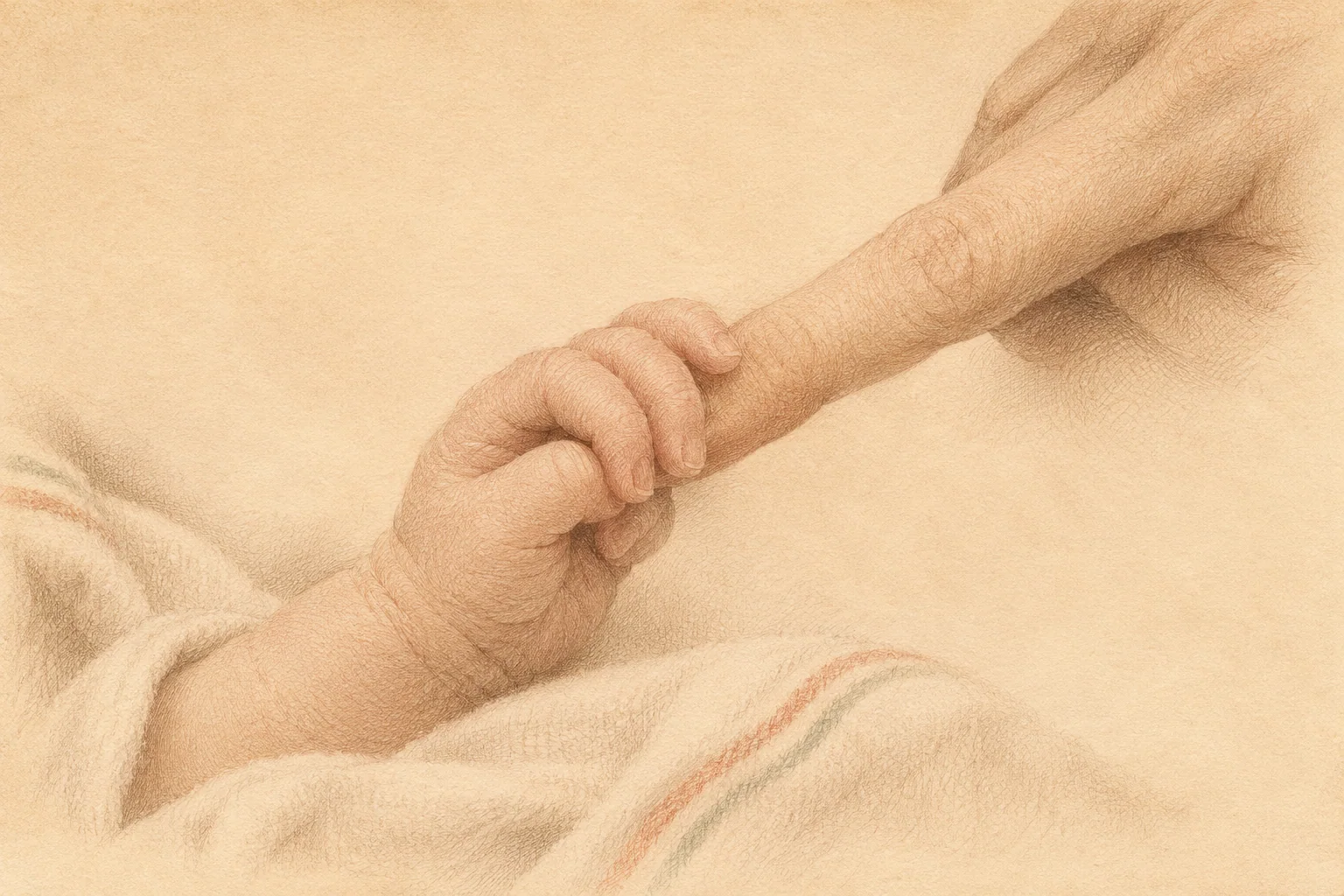
An imagined first Mother’s Day in Mission Hills.
Of all the dates we’ve put into the car, this is the one where I’d turn the engine off.
Mom, if I could borrow five minutes from any day in your life, I know which day I’d pick. May 10, 1981.
You were eighteen. I was one day old.
If I could borrow five minutes from that Sunday, I’d ask you how you were feeling. Then I’d give you the hug a one-day-old boy couldn’t manage.
I’ve just spent a couple of hundred years chasing people I can’t sit down beside. You and I can open this book, turn to this page, and spend those five minutes together.12
By Nov. 1990 · At Ruby’s and Mary’s
The house with two soundtracks
The Dodgers are on television at Ruby’s house. You can see the game just fine. But if your eyes are on the screen, your ears are pointed somewhere else. Ruby has Vin Scully on the radio.
She explained that she liked his call better. I’ve forgotten her exact words. I remember her ruling. A person could buy my great-grandmother a television. That did not mean she was going to let whoever came with it call her ballgame. With the Lakers she had Chick Hearn. Ruby knew how she liked things to sound.
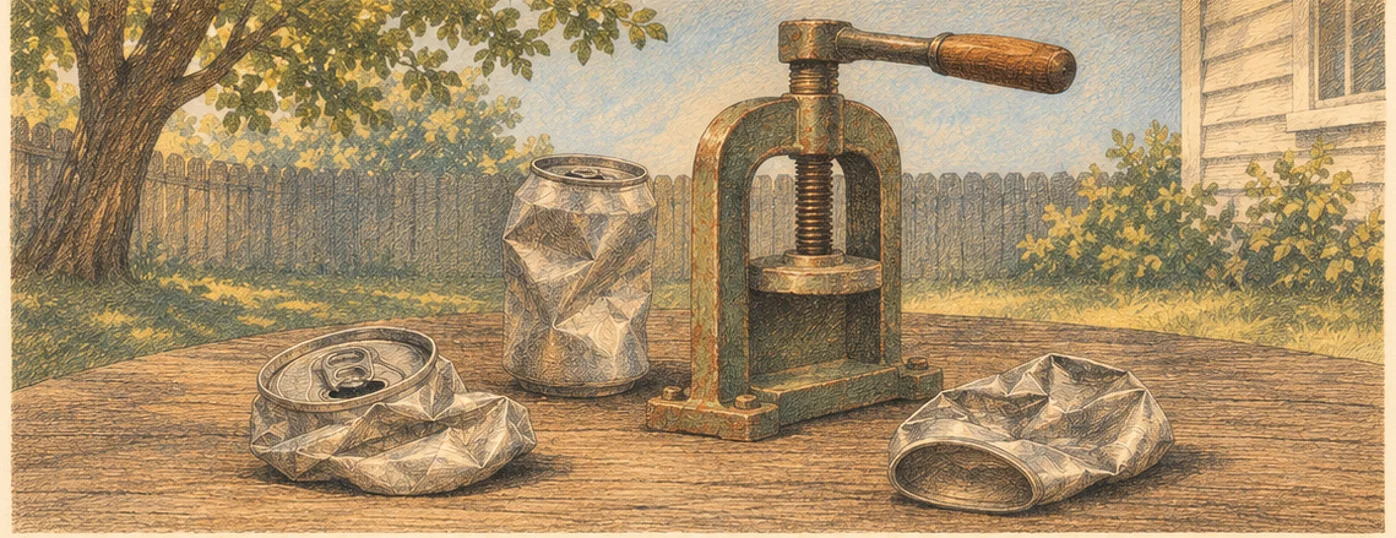
I remember watching Jeopardy! with Grandma Mary once. Another time she let me crush aluminum cans with the can crusher in her backyard. I remember how much fun that was.
The last time I saw her, she was asleep in the hospital. When she passed in November 1990, she was forty-eight. My mother was twenty-seven. I was nine.
When Mom was around thirty, she found her father, George Smith, in Costa Mesa. They had a little time together before they lost touch again, years before he passed away.
The part I remember about him is a Christmas present. He gave me a Chicago White Sox jacket. The boy in the jacket didn’t understand what it had taken for those two people to meet again.
I got to meet my grandfather because you took that first step. I know enough now to thank you.9 · 11
2007 and after · A remembrance • Utah
Auntie Anne’s invitation
On November 8, 2007, you wrote about your mother, Mary.
“Everyone called her Trudy.”
Those are your words about your mother. You put them down seventeen years to the day after she died. You remembered her generosity, how deeply she cared about people, and how much you missed her.
Auntie Anne put her sister’s whole name in the first sentence of her invitation. This is what she wrote to the family.
“Family I am hosting this gathering in in Utah to honor my sister, Mary Gertrude Wallace Smith Gaughan. Everyone coming is here because she was someone who created family through love, blended, and biological. We can look forward to seeing family we haven't seen in a while and meeting new family.”
I love that Anne called them family before some of them had even met.
I didn’t make that trip. My relatives told me they had a wonderful time. What I can tell you is that my mother and her brothers and sisters could turn to Anne. Sometimes what an aunt gives you is a shoulder to cry on and time enough to stay there.9 · 13
1981–2026 · Stephani and her family
A trophy and a vacation
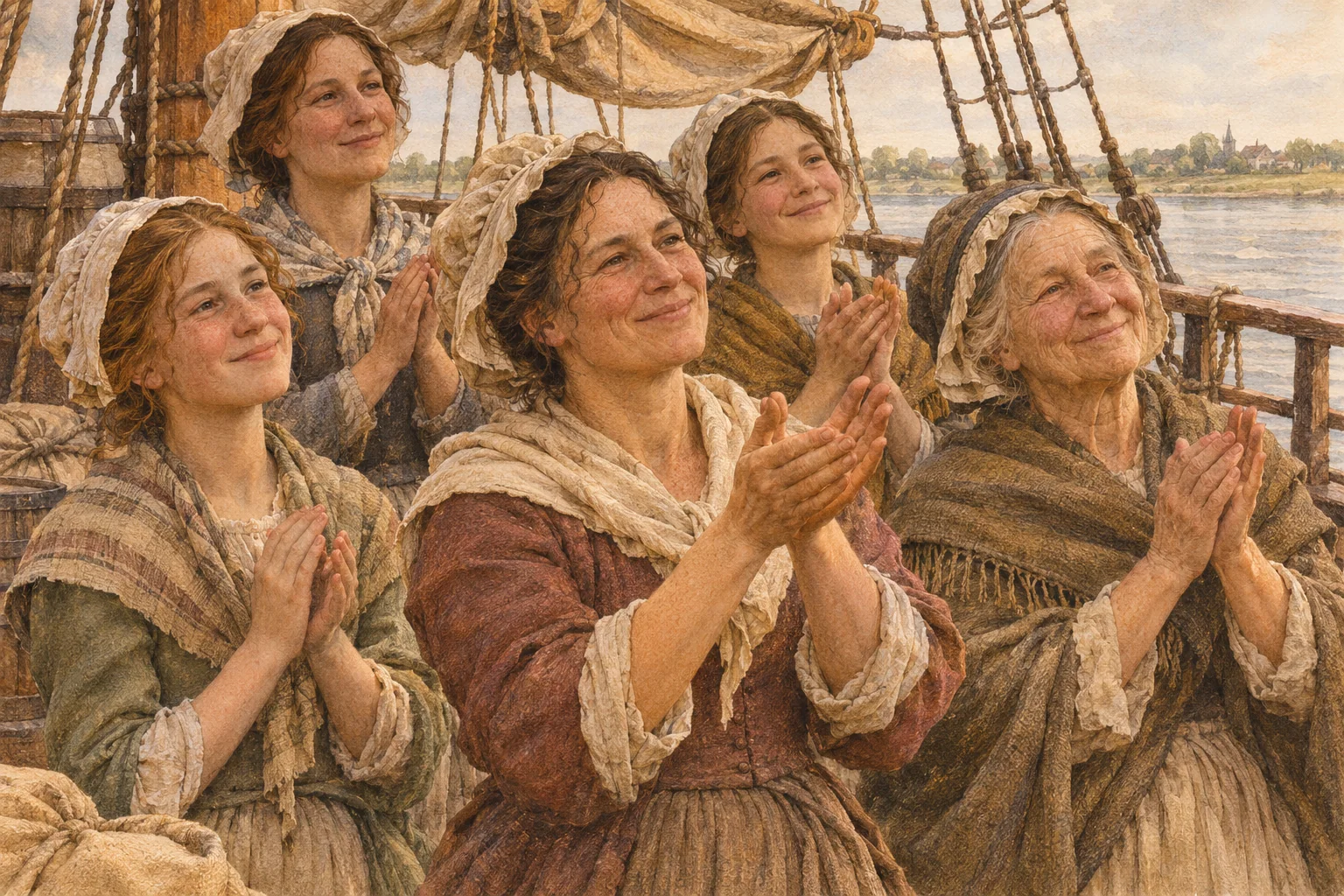
The women and girls of the Catharina applaud Stephani in Joseph’s imagination.
The day I was born, you were eighteen. You’re in your sixties now. For more than forty years, there’s been a kid at home who could count on you. First came the four of us boys. Now you have several grandchildren, and you’re still going.
Samantha, your husband Marco’s daughter, was a mother of four when we lost her. Those kids lost their mom. You and Marco are helping raise them. Years from now, they’ll have their own words for what it meant that you were there. For now, these are mine. You deserve a trophy. And a vacation.
I keep thinking about the girls and women on that ship. If I could pull the DeLorean up alongside the Catharina one more time, I’d tell them about you. I can picture one woman setting down what she’s carrying to clap. Then the girl beside her joins in. Pretty soon you can hear them from the dock. That round of applause is for you, Stephani.13
Fall 2026 · Back in Burbank
Back home
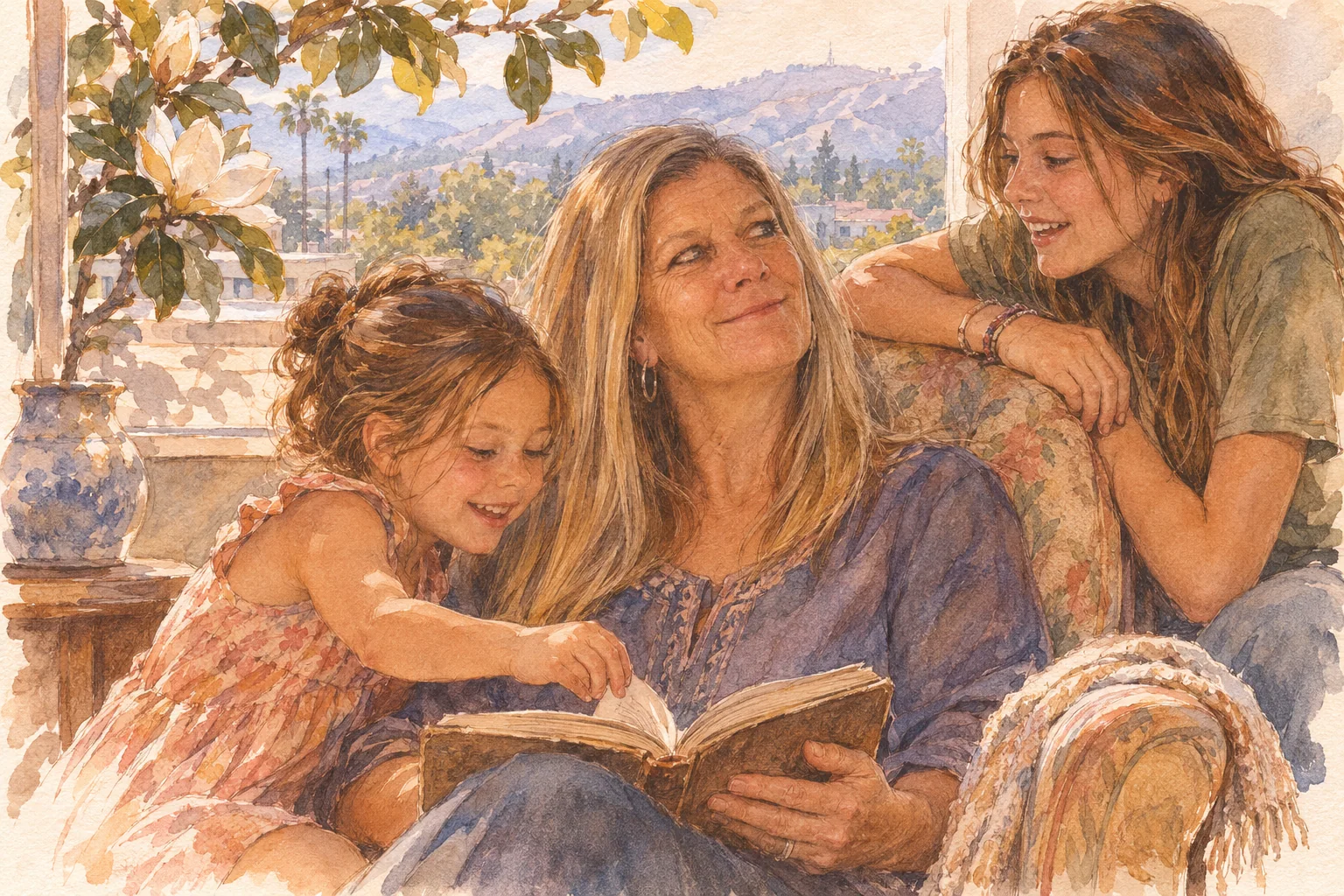
I want to give my mom something I was too young to give hers. An afternoon when she gets to be the girl in the story and I’m the one who listens.
I kept the promise I made in that imaginary hospital room. When my first daughter was born, I gave her your name, with that extra e. On paper it’s a single letter. Every time I write it, I think of you.
And to all the grandkids reading along, don’t worry. We can wait to read your version one day.
I made this book for you because I want you to know how glad I am that I came from you.
Our next family trip should be to Markham. I think it’s fair to say our day has come. Look at us now.
And now, Mom, my girls get to call out “Grandma!” and see you turn around. That’s the part I wish I could show Mary in that room.
Hermann Pfaefflin printed Johann Gottlob Schellenberg’s agreement in his 1915 history. The service term starts on the left. Clause 3 on the right sets out what the recruit could earn. The date near the bottom is Hamburg, April 28, 1792.
Hermann Pfaefflin, Hundertjährige Geschichte des Deutschtums von Rochester (1915), printed p. 13. · Hermann Pfaefflin, Hundertjährige Geschichte des Deutschtums von Rochester (1915), printed p. 14.Source 1 · Source 21
What the family carried
The closed chest is over four feet wide. Opening the lid gives a sense of what one family could take with them. The museum preserves it as object M.L.1980.6.
The museum reads the two carvings across the front as “Jochim Pingel 1757.” Below them are the keyhole and a carrying handle. The year is thirty-five years earlier than the sailing. Its meaning remains unknown.
The Town of Markham recorded the Helmke family’s account in the historical description of a house. The first paragraph under “Historical Attributes” names the father and son who sailed together.
Town of Markham, By-law 2004-214, Schedule B, printed page 3. Ontario Heritage Trust.Source3
Johan notices the water
Francis was five. The town credits his father, Johan, with finding the shortage that led to a stop at Newport. This account was recorded in 2004, more than two centuries after the voyage.
Ralph Beaver Strassburger and William John Hinke, Pennsylvania German Pioneers, vol. 3, list 370, p. 50.Source3
Pilip, twenty-four
On the right column, the printer set “Pilip Ekhart, 24 years old.” Farther down comes Jochim Pingel with his wife and five children. Here their names still travel together.
Ralph Beaver Strassburger and William John Hinke, Pennsylvania German Pioneers, vol. 3, list 370, p. 50.Source3
A passenger remembers
John Henry Sommerfeldt helped see to the provisions. This is the first complete page of the English translation of his account. The upper lines describe the crossing. Halfway down the page, he is in Philadelphia buying tools.
John Henry Sommerfeldt, diary, c. 1794, English translation, translator unknown. Markham Museum, document 43, p. 1. · John Henry Sommerfeldt, diary, c. 1794, p. 1 part a. Markham Museum.Source 1 · Source 23 · 4
Twelve wagons and 125 loaves
In the upper passage he buys shovels, spades and hoes and spends three days loading twelve wagons with nothing to eat. Farther down he is baking and carrying wood. His task was to provide 125 loaves every other day.
John Henry Sommerfeldt, diary, c. 1794, English translation, translator unknown. Markham Museum, document 43, p. 1.Source4
Their own account of what went wrong
These are two successive leaves of the settlers’ German appeal of August 6, 1793. Jochim Pingel’s name is on manuscript page 50, at left. Look near the middle of page 51 for the lighter ink.
Settlers’ German-language address, August 6, 1793. Library and Archives Canada, William von Moll Berczy fonds, MG 23 H II 6, handwritten p. 50. Digitized by Canadiana. · Settlers’ German-language address, August 6, 1793. Library and Archives Canada, William von Moll Berczy fonds, MG 23 H II 6, handwritten p. 51. Digitized by Canadiana.Source 1 · Source 24
Two names, two hands
Jochim Pingel’s name stands out in dark ink on the first leaf. The lighter name on the next leaf is read as Philip Ekhard. Putting the two enlargements together lets you see the difference in the handwriting.
Settlers’ German-language address, August 6, 1793. Library and Archives Canada, William von Moll Berczy fonds, MG 23 H II 6, handwritten p. 50. Digitized by Canadiana. · Settlers’ German-language address, August 6, 1793. Library and Archives Canada, William von Moll Berczy fonds, MG 23 H II 6, handwritten p. 51. Digitized by Canadiana.Source 1 · Source 24
Philip and the house that survived
The log-house study identifies the man at left as Philip Eckardt. The photographer and portrait date are unknown. At upper right is his house in 1885, long after his lifetime. The lower photograph shows the house nearing the end of its restoration in 2020.
William D. Finlayson and George W. J. Duncan (2021). Figure 2.5, printed p. 9. Kathleen Gormley McKay collection, courtesy of the York Pioneer and Historical Society. · William D. Finlayson and George W. J. Duncan (2021). Figure 2.7, printed p. 14. Markham Museum, M.1988.0.192. · City of Markham Heritage Section. Figure 2.14 in W. D. Finlayson’s study of the Eckardt Log House.Source 1 · Source 2 · Source 35
The family on the Sixth Concession
Under “Sixth Concession” the enumerator wrote the Eckardt household on a single line. Read along the columns for the parents and then the children.
William Berczy fonds, Library and Archives Canada, microfilm H-2298, frame 135, via Canadiana. Full-resolution scan retained in the family’s Philip Eckardt account, page 4.Source5
Three boys in a row
Under the column headings, the handwriting places Philip, Henry and George beside their ages of five, four and one. Elisabeth appears in the household. This return records who was there that year.
William Berczy fonds, Library and Archives Canada, microfilm H-2298, frame 135, via Canadiana. Full-resolution scan retained in the family’s Philip Eckardt account, page 4.Source5
Florence registered two daughters
December 23, 1915, Pelham Township. Ruby Catharine’s birth is at upper right. Ruth Eliza’s is at lower left. Florence recorded the two girls on opposite sides of this one page.
Ontario birth registrations, p. 149, via Ancestry.Source8
Ruby and Ruth, side by side
Each entry gives December 23, 1915. Look below the birth date for the space recording a multiple birth. The same word appears twice, once for each sister.
Ontario birth registrations, p. 149, via Ancestry.Source8
The first June 22
John Braceland Wallace and Ruby Catharine Tunnacliffe married in Welland on June 22, 1940. The place and date appear at left on the complete registration, then again in the enlargement below. Six years later came Ruth’s wedding on the same day of the year.
Ontario, Canada, Marriages, 1826–1944, image 7921_09bf6d4b_0209-00208, via Ancestry.Source8
Ruby at her sister’s wedding
At left is Ruby Catharine Tunnacliffe Wallace. At right, the contemporary newspaper calls her Mrs. J. B. Wallace, twin sister of the bride and matron of honor. It describes the attendants’ red roses, white sweet peas and fern. The surviving excerpt is shown in full.
David Weir, Van Wyck family tree, Ancestry. Photographer unknown. · Welland–Port Colborne Evening Tribune, June 25, 1946, p. 3. Newspapers.com.Source 1 · Source 28
A girl named Mary in Detroit
In the 1950 census, look to the upper part of sheet 1, at the household with the surname Wallace. Lines 8–14 run from Charles and Gertrude down to Mary’s little brother William.
U.S. Census Bureau, 1950 Census of Population and Housing, U.S. National Archives.Source9
Mary is seven
The ages form their own little portrait of this household. Mary is seven, her brother John is six, and William is three. Listed just above them are Ruby and John.
U.S. Census Bureau, 1950 Census of Population and Housing, U.S. National Archives.Source9
George before he was Grandpa
The 1958 Cathedral Boys High School yearbook in Springfield, Illinois, places George H. Smith at lower right. His photograph and activity line appear again at right. The school listed him in the variety show, glee club and track.
1958 Cathedralogue, image 40, Cathedral Boys High School, via Ancestry. Photographer unknown.Source9 · 11
Mary’s page in the yearbook
Glendale High School’s 1960 Stylus, page 93. The group posed above the words “Latin Club.” On the left the student editors printed the members’ names. At lower right they described the club’s cookie sale and scholarships.
Glendale High School, 1960 Stylus, p. 93, via Ancestry. Photographer unknown.Source9
Find Mary in the club roster
Her name breaks across two lines, “Mary Wal-” and “lace,” between Shelly Stimson and Mary Salyer. Joseph tentatively recognizes her among the standing girls near the right. The roster confirms her membership. The other excerpt tells what the club did for its students.
Glendale High School, 1960 Stylus, p. 93, via Ancestry. Photographer unknown.Source9
The day Stephani was born
Bob Gregg kept a high-and-low table at his Glendale foothill station. This is the complete March 1963 sheet. March 13 is near the middle of the left column.
Bob Gregg, Weather Station No. II, Glendale foothills. March 1963, sheet 22.Source10
From the hillside to Brand Boulevard
On row 13, Gregg’s low is 41°F and his high is 79°F. Below, a Los Angeles Herald Examiner photograph shows Brand Boulevard in Glendale on August 23, 1963, a little over five months after Stephani’s birth.
Bob Gregg, Weather Station No. II, Glendale foothills. March 1963, sheet 22. · Herald Examiner Collection, Los Angeles Public Library, image 00047171.Source 1 · Source 210
Sources and family notes
1. What a man signed away on the Elbe
Altona stood beside Hamburg, under the Danish crown in 1792. David Minor dates the Catharina’s departure to May 2 and her passage into the open Atlantic to May 8. The dockside trades are documented. No observation for that particular morning has been located. One surviving contract belonged to Johann Gottlob Schellenberg. For six years’ work he was to receive passage and thirty-six Spanish thalers annually. Saving four a year could earn twenty-five acres, livestock and poultry. Philip’s individual contract has yet to turn up.
Markham Museum records a blanket chest 135 centimetres wide, made of six dovetailed boards. It has iron hinges, handles at both ends and three upright bands of flowers. The catalogue reads the inscription as “Jochim Pingel 1757.” Its maker and the reason for the date remain unknown. Markham research identifies Ann Elizabeth Koepke as Philip’s wife and Maria Koepke, Ann’s sister, as the wife of Jochim’s son George. Philip later named George a co-executor of his will. The chest belongs to the family story through those marriages.
John Henry Sommerfeldt remembered thirteen weeks at sea, twice-weekly scrubbing and the smell of vinegar and juniper used to fumigate the ship. Markham’s Helmke family history credits Johan, whose five-year-old son Francis sailed with him, with discovering the shortage that led to fresh water at Newport. The surviving Philadelphia list names “Pilip Ekhart,” age twenty-four, and Jochim Pingel with his wife and five children among 132 passengers. Accounts give July 22, July 28 and August 3 for arrival. August 3 is the date on the list’s endorsement. A Newport water receipt has yet to surface.
4. The settlement that failed and the people who helped
Sommerfeldt describes the Philadelphia purchases, three days loading twelve wagons without eating, carrying firewood, and later supplying 125 loaves every other day. The settlers’ 1793 petition gives the numbers of huts and axes and their understanding of the promised terms. Cowan documents the winter journey and imprisonment of settlers at Canandaigua. Stagg identifies Charles Williamson, the guards, and the help of Indigenous people from the Grand River and men hired by Samuel Street. He describes the group reaching Upper Canada in late June 1794 and settling at Markham by year’s end. His account does not give the helpers’ individual names or say the guards pointed guns or fired on the families.
Philip married Ann Elizabeth in 1794. He farmed, cleared obstructions from the Rouge and built a flat-bottomed barge. Neighbors worshipped in their log house. The 1803 household return gives Philip, five (about 1797–98), Henry, four (about 1798–99), and George, one (about 1801–02). Daughter Marie, also called Mary, was buried near the house that year. Family and local histories name Gottlieb, Frederick, Andrew (1811) and Salem (1824), and count seventeen or eighteen children. Duncan dates Philip Sr.’s marriage to Ann Elizabeth to 1794 (p. 10) and credits their eighteen children to Markham Museum genealogy (p. 13). The city dates the adult Philip Jr.’s birth to 1803, while a Philip listed in the 1803 household was already five. Both dates fall during Ann’s marriage. We have not found the younger Philip’s baptism or a record naming a different mother. The 1827 land history names his father (note 6).
Markham’s land history identifies the elder Philip as the father who sold Philip Jr. one hundred acres in 1827. Philip Jr. married Susannah Hegler in 1829. Their children were Sarah Ann (1832), Thomas Philip (1833), Andrew (1837), Barbara Ann (1840) and Edward (1841). Andrew and Barbara Ann died young. Thomas became a physician. Edward inherited the farm in 1874. Their brick house overlooked the Rouge and had four chimneys. The younger couple took in a visiting student minister. An 1851 census, enumerated in 1852, finds Sarah Ann, Thomas and Edward at home.
Edward Eckardt married Catherine Braithwaite in 1869. He registered their son Homer Mark Philip, born October 24 that year. Homer’s uncle, Dr. Thomas P. Eckardt, attended the birth. Other records name Clarence (about 1871–72), Florence Gertrude (1876), Maude (1880), Jessie (1881), Eva (1883), and twins W. Roy and Wilhelmina (November 21, 1885). The Markham farm was sold in 1883 and returned to Edward and Catherine together in 1886. By 1891 Edward was growing fruit in Pelham. The 1901 census gives the twins’ same birthday on neighboring lines.
Office clerk Florence Gertrude Eckardt and nurseryman George Tunnacliffe married in Ridgeville on March 20, 1903. Her sisters Eva and Maud witnessed the marriage. Their children were Jean Ladell (1903), Eve Gwendolyn (1905), Marion (1909), Ruby Catharine and Ruth Eliza (December 23, 1915), and Donald (about 1918–19). Florence registered the twins separately on the same page. Ruby married John Braceland Wallace on June 22, 1940, in Welland. On June 22, 1946, Ruth married Edwin Albert Hilder. The local newspaper identifies the matron of honor as Mrs. J. B. Wallace. Ruby spent her sixth anniversary beside Ruth. On page 3, the June 25 newspaper names the bride’s twin as matron of honor. Both attendants wore red roses, white sweet peas and fern in their headdresses and carried matching bouquets. The watercolor depicts Ruby’s flowers. The surviving family clipping reproduces the paragraph about the attendants.
Mary Gertrude Wallace was born in Detroit on April 8, 1942. In the 1950 census she was seven, John was six (about 1943–44) and William was three (about 1946–47). Bill’s later notice names his siblings Anne and John “Mike.” Other family evidence suggests Bill was the son Ruby called George. Mary Wallace appears in Glendale High’s 1960 Latin Club roster. The club funded scholarships with a cookie sale. Identifying her face in the group is tentative. Mary married George Howard Smith in San Diego County on November 25, 1960. Joseph recalls one occasion watching Jeopardy! with Mary and another crushing aluminum cans with her backyard can crusher. Joseph recalls his mother finding George in Costa Mesa when she was around thirty and remembers the Christmas jacket. Anne’s invitation is family correspondence preserved in the earlier edited Pages manuscript.
California’s birth index records Stephani A. Smith on March 13, 1963, in Los Angeles County, with Wallace as her mother’s maiden surname. The family remembers Glendale. At his Verdugo foothill station Bob Gregg recorded a daily low of 41°F and a high of 79°F. Regional streetcars were in their final weeks of service. The last scheduled runs were March 31. Ruby and the Romantics’ “Our Day Will Come” was second on Billboard’s March 16 chart and first on March 23, when Stephani was ten days old. The same chart ranked “Walk Like a Man” first and included Johnny Mathis singing “What Will My Mary Say.”
Stephani remembered five boys and three girls. Joseph recalls Kevin Smith, Timmy Smith, Ricky Gaughn, Michael Gaughn, Patrick, Stephani Smith, Windy Gaughan and Cindy Gaughan. Mary’s notice calls the girls Windy and Cindy. The birth index gives Wendy S. (1969), Cynthia A. (1967) and Michael W. Gaughan (1970). Kevin was born in 1961 and Timmy in 1964. Ricky’s given name comes from Joseph because the available obituary excerpt cuts off a son’s name. Patrick’s adoption and reunion also come from Joseph, who has no confirmed surname. The childhood loss remembered by the family remains unidentified. George’s notice also names Christopher and Carol Smith, and stepchildren Jim Trucano Harp and Eric Harp. These belong to Stephani’s paternal family.
Joseph’s family account places Stephani at John Burroughs High in Burbank, where Joseph and Anthony later went. Her childhood memories belong to her. The imagined conversation with newborn Stephani and Mary is Joseph’s tribute. The Dodgers swept the Yankees in 1963 and beat them four games to two in 1981. Joseph gives his birth as May 9, 1981, in Mission Hills, eighteen years and fifty-seven days after Stephani’s birth. President Reagan’s proclamation designates Sunday, May 10, as Mother’s Day. Mother and son spent their first one together when he was a day old. The night before Joseph was born, Fernando Valenzuela struck out eleven Mets in a 1–0 Dodgers win at Shea Stadium.
Joseph Valenzuela’s family account, November 25, 2026, names Stephani’s four sons as Joseph, Anthony, Marco and Matthew. He recalls more than forty years with a child in her home. He remembers Samantha, the daughter of Stephani’s husband Marco, as a mother of four. After Samantha’s death, Stephani and Marco are helping raise her children. The salute aboard the Catharina and the closing watercolor are imagined scenes illustrated with AI assistance. Minor League Baseball records the Phillies’ selection of catcher Matt Quintanar in the sixteenth round, 489th overall, in 2026. Joseph identifies Matthew as his youngest brother. Joseph’s private DNA results can guide research. The family relationships in this account draw on testimony, civil and church records, censuses and land history.